
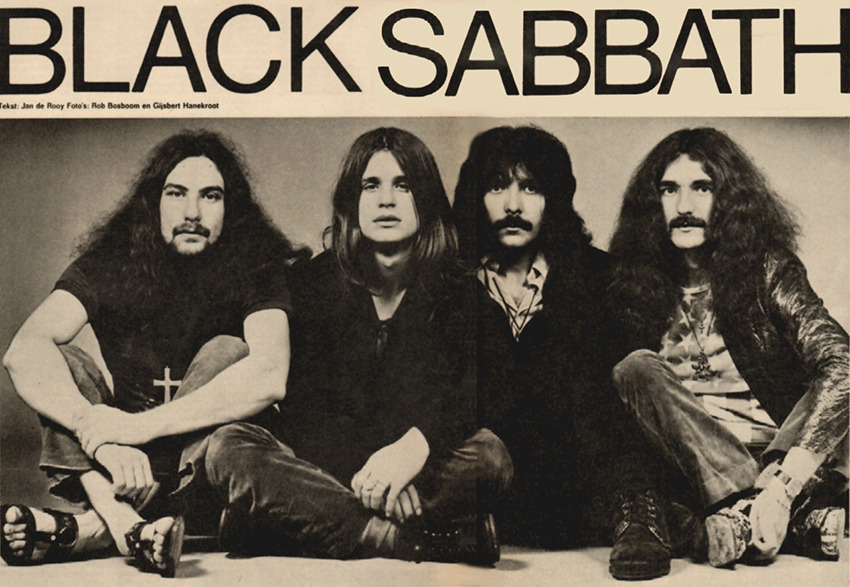
Written by Andreas Andreou
SATAN, COCAINE, GOLDEN RECORDS, USA: 1971 ON THE ROAD.
During 1970, Black Sabbath released two albums (Black Sabbath, Paranoid) and from small clubs they went on to tour in the United States while their albums met a huge commercial success despite the negativity of critics and the press that couldn't see at that moment what was happening. Reviews of the albums at the time were savage. The key to commercial success though, always had to do with the USA too; if a band managed to tour in the USA and enter the charts, success was in sight.
The United States of America was a completely different world than Europe and England half a century ago, and the 22-year old fellas from Birmingham got to learn about it and even changed their perspective of the world. When you travelled in the USA in 1971, you could see headlines about Ku Klux Klan bombing school buses, a bomb on a plane, a bomb here and there, the Attica Prison riot, and of course the Vietnam War was still raging. But 50 years ago, there were more things that nowadays sound like they don't matter or they're just "old news" and a "stupid thing". In 1971 in the USA, you had the sentence of Charles Manson after the "trial of the century", and you could also see the founder of the Church of Satan, Anton LaVey, in the cover of the famous Look magazine. "It's a satanic world", Geezer Butler told Rolling Stone magazine that year, and Satanism was a "thing" back then in the USA. "Satan" was a word mentioned with fear in the society half a century ago. Things were different.

In that world (the USA), Ozzy Osbourne, Tony Iommi, Geezer Butler and Bill Ward met all kinds of weirdos and people who invited them to Satanic ceremonies and black magic gatherings since they had the fame of devil-worshippers. They got praise from followers of Charles Manson, even Anton LaVey himself, who (according to Tony and Ozzy) arranged a black magic parade in San Francisco honoring the band with a "Welcome Black Sabbath" banner. They never really understood it but that was America; A different world. And keep in mind that we're talking about something different: That was the context of the world half a century ago.
Years later, the Church of Satan said that the black magic parade was a myth, but in this world, Black Sabbath was often related with black magic and Satan even if they had just a handful of songs about Old Nick and they always denied every connection with that - they even made fun of it. They had a dark vibe, a presence of an invisible fifth member and the Devil's interval, the tritone, and THE RIFF, but that's all; it just gave birth to Heavy Metal.

However, when Ozzy parted ways with the rest and everyone entered the '80s, things changed, heavy metal music became something different and both parties (Ozzy in his solo career and what Iommi did with the Black Sabbath moniker) embraced the dark image and all those myths. Ozzy became the bat-biting Prince of Darkness and sung songs about Aleister Crowley and Manson's murders, while Tony Iommi wrote riffs about the hill of the headless cross and Satan, even added a red devil baby in the cover of a Sabbath album. Well, they kept wearing crosses, just like those Ozzy's father made for the original 4 in the early days that were supposed to keep them safe from evil eyes and evil possessors but things really changed in the '80s. According to the "image", Tony Iommi made most of the people that entered the Sabbath timeline in the '80s wearing crosses, just like those Ozzy's father brought. That was the '80s, the second decade of cocaine that became the devil's daughter for both Ozzy and Tony who were seduced by her, but let' go back to 1971...
Black Sabbath started writing the first new songs on the road, while touring in the UK (with a short visit in Australia for the Myponga Pop Festival) but they stopped since the management and labels asked them to visit again the USA for touring since Paranoid got its US release by Warner Bros. Records a few months later than the Vertigo UK & European release. The band played in the USA until April, and a few shows followed back in Europe with the last one at the Royal Albert Hall in London, England, on April 26th of 1971. The show in Royal Albert Hall was supposed to be during the January British tour but the band was banned because of their image, their lyrics and their music. Promoters were afraid.

In just a few months, both Black Sabbath and Paranoid achieved gold status and a third tour in North America was booked starting in July 1971. Black Sabbath had just a few weeks until May to finish their third album and continue touring, in a schedule that nowadays looks unreal and impossible.

Before even releasing Master of Reality, Black Sabbath had already performed more than 200 shows (sometimes performing two shows at the same day) let alone all those shows during 1968 and the first half of 1969 before changing name to Black Sabbath. While the first US tour was something like a successful experiment, the following ones and the shows they performed, made them one of the biggest bands of the planet. The audience went mad when Ozzy, Tony, Geezer and Bill were on stage and even if that was just the beginning, they were already old dogs but they never stopped learning new tricks. Black Sabbath continued in North America until late-October 1971. When 1971 came to an end, Black Sabbath had already performed an estimated number of 300 shows. Think about it for a while. And it was not just that. They continued touring supporting Master of Reality in the United Kingdom during January and February of 1972 while in late-February they returned to the USA for more shows until April 1972, adding an estimated number of 50 more shows!
We've said the USA changed the band's perspective of the world. They were already introduced to marijuana and different kinds of pills but in the world of America the hard-line drug-dust came in front of them just like pizza and all those groupies, weirdos and freaks, among the thousands of fans. Tony Iommi must have been the first one who did cocaine while Bill Ward and Ozzy Osbourne shortly followed during some LA nights. Ozzy was introduced to cocaine by Leslie West of Mountain, a guitarist that was a huge influence for another important person in Ozzy's timeline: Randy Rhoads.
Master of Reality was certified gold from advance sales before it was even released. In a period of two years, from late-1969 to late-1971, Black Sabbath shaped different heavy genres of music, inspired countless people, released three albums and went from small clubs in England to headline shows of thousands in the USA. That was the end of innocence and the beginning of a new era. "I feel the band is getting very influenced by the American trip", Ozzy said to Melody Maker in 1972, when they were somehow relocated in the United States, and influence for every new song was coming from the world. It was just a different new world, so that's what the music was about: the daily life and social chaos, drugs, pollution, war and evil, supernatural and the afterlife. Still though, there were also moments of happiness and love within those songs.

Black Sabbath at Central Park, NYC. August 15, 1971 (photo by Bob Gruen)
WHEN WAS "MASTER OF REALITY" ACTUALLY RECORDED?
The most confusing thing is the period the album was actually recorded. According to various sources, Master of Reality was recorded during February-April 1971 in Island Studio in London, while Tony Iommi wrote in his biography Iron Man (First Da Capo Press paperback edition, 2012, page 94) that the album was recorded in February and March of 1971, and he's also mentioning they had two weeks to record Master of Reality. In the kind of life of people like Tony, Ozzy, Geezer and Bill, exact dates are not something that's really certain when they're asked about it.
For sure, the album was recorded in London with producer Rodger Bain for the third and final time, and Tom Allom engineering. But it wasn't recorded during March, since by mid-February until early-April, Black Sabbath were touring in North America. Then, they returned to Europe for a few more European dates in Scandinavian countries with the last one in London, England, on April 26th of 1971. So, the album is either recorded after that date in May or June of 1971, or before February 1971, or just those few days during early April after the North America tour and before the few European dates.
So, when was Master of Reality recorded? Maybe they worked on a few basic tracks after Christmas of 1970 up to early January 1971 but surely entered the studio early-February for a few days. The final recordings were probably in a week during early April and/or completed in May 1971.
The album was released in both the UK and the USA on July 21, when they were already back in the United States for another major tour.


THE ALBUM. THE SONGS. THE LEGACY.
Recorded with producer Rodger Bain, the album is the perfect follow-up to Black Sabbath and Paranoid. Primal and gloomy, heavy and honest, Master of Reality is the end of innocence for the band members before they will move on to more ambitious and experimental albums as established rock stars, without any specific few-days recording limitation from record companies and management, or producers like Bain claiming part of their glory.
Down, down, down-tuned, Master of Reality was the heaviest album on earth upon its release. The heaviest thing the world witnessed up to that moment. It was the year where the term "heavy metal" also started appearing in magazines more often and found its true meaning in describing that specific genre-defining album that became the blueprint for all-things heavy, different sub-genres and music styles that followed years (even decades) later. Master of Reality was the heavy metal music of its time.
However, a few people and writers are often confused and believe that Tony Iommi down-tuned his guitar for the album but that's not really correct. Iommi did it in just three songs: "Children of the Grave", "Lord of This World" and "Into the Void". "They were played with guitars detuned three semitones to sharp C", an expert - musician would say, and I guess that's the exact musical term for what Iommi did. But why did he do it? After countless live shows and days on stage, the pain in his chopped fingertips was constant. The sound was already heavy but with the down-tuning he reduced the string tension and that was easier for him to perform the mammoth riffs. Then, Geezer Butler also down-tuned his bass to match the Riff Master and Ozzy started singing higher to balance everything.
Today, there are many audio engineers and people in the music industry, and when something (very) heavy and sludgy appears, sometimes, someone will say "it's not properly recorded", while others are lost in overproduced albums that you can't really listen to all the instruments and music elements properly. Labels didn't change Black Sabbath's music, and "social media experts" of the modern age was something that didn't exist, but it would be fun to have them back then speaking about "a bad production", "average vocals" and "sloppy playing". Thankfully, 50 years ago nobody affected Sabbath's sound and the history of music changed. With all its "faults", the "you can't do that!", and "maths" that are not right; because simply, music is not just maths and it can be something more. Frank Zappa once explained it better. In the end, Black Sabbath really did everything their way. With weird riffs for the time, different changes, sounds and tempos "that's not going to work!" even within the same track. They made it work. Thankfully.

There wasn't any single prior to the release of Master of Reality. "Paranoid" (the song), a last-minute track requested by the label for the previous album, was a huge hit, but Black Sabbath had a different perspective and they never repeated it or looked for it in the '70s; the "hit", a label wanted. They even talked to the press about those pop "screaming kids" you could see in mainstream acts. "We don't need those fans. And we're not changing our act just to please kids who bought the single", Sabbath's comment was in the Disc and Music Echo magazine.
Inspired by the "It's the sweetest leaf" slogan of Sweet Afton cigarettes from Ireland, "Sweet Leaf" begins with Tony Iommi's echo-coughing after a big joint offer by Ozzy and taped in the studio. The blueprint song for the '90s heavy and stoner rock music is a love song but it doesn't involve people, just the love for marijuana ("I love you sweet leaf"). Just like "Sweet Leaf", "After Forever" was also a song raising controversy with lines like "would you like to see the Pope on the end of a rope - do you think he's a fool?" but the song is not against Christ and God, it is just a song criticizing the Catholic Church and the "people like you that crucified Christ". Geezer Butler, a raised Catholic, writes "they should realize before they criticize, that God is the only way to love" giving also one of the first lyrical contents to '80s bands like Trouble but also white (or Christian) metal.
"Embryo" just serves as the intro to "Children of the Grave", "a little classical thing to give it all a little space and create some light and shade" as Tony Iommi writes in his autobiography. Of course, while Sabbath was all the time on the road and with all previous song ideas used in the first two albums, they have limited time writing new songs, so those small instrumental parts, besides sharing a similar purpose, the out-of-the-box light in darkness and gloomy vibe, were bits that extended the album's tracks. And then, you have one of the most iconic Sabbath (and heavy metal in general) tracks, "Children of the Grave". Arriving from a working-class life at the height of the Vietnam War, Black Sabbath echo the world of late-60s and early-70s from the eyes of the youth. In the first verse, Ozzy sings about children who start to march against the world in which they have to live, and in the last verse, he talks to them: "Show the world that love is still alive, you must be brave, or you children of today are children of the grave". It's a warning to the children of that era, the kind of song that the youth of the early-70s was connected with, felt and loved, despite the criticism of the media against Black Sabbath. Having a Hammer Horror vibe, this song is a work of genius, from Iommi's galloping riff that influenced almost everything in heavy, epic and power metal in the '80s, to Bill Ward's overdubbed timbales and Ozzy's desperate "yeah!" at the end of each verse. "Children of the Grave" was revolutionary and besides its music, it was lyrically a huge influence for what followed the next years.
"Orchid" is another Iommi acoustic piece, adding light and colour within the shade and darkness, following the revolution of children of the grave before the devil song; one of the few actually Sabbath wrote in the '70s about Old Nick, Satan, the evil possessor that becomes your confessor. "Lord of This World" was a sinister song for the context of 1971. The riff and the change after a few seconds but mainly Ozzy's performance gave that threatening element, adding also the trademark "yeah" in the end of the first verses. It's one of those Sabbath tracks that Ozzy's voice becomes the soul of the song, playing the role of Satan himself, and after the final verse, Iommi and Butler lead the song to glorious heights proving that the chemistry of the original Sab-4 was perfect and was never reached again in such a continuation.
There was a debate for years about who's really singing on "Solitude". Of course it is Ozzy and that was Sabbath's first true love song including flute and piano by Iommi. Ozzy's pessimistic and eerie performance on lines like "the world is a lonely place, you're on your own" is another shivering moment that gives to Sabbath's gloomy vibe a new dimension adding also an ambient element. That's what made Ozzy the voice of Black Sabbath and no one sang the '70s song better. It doesn't matter who has the better voice because Oz is the character for those specific cuts. His voice became the emotion and the feeling of those songs. He became insanity, the drug, the loss and the depression, the anger, the possessed. You can't control those feelings, therefore you must be them in order to be convincing, and Ozzy was all of them.
And finally, you have the end of the world. "Into the Void", the apocalyptic horror with pollution killing the air, hate and fear bringing mankind to the final suicide, leaving the earth to Satan and his slaves. Just a few freedom fighters escaped the brainwashed minds and those could be the warned children of the world that escaped the grave. Lyrically, this is another song - warning, while musically, it is one of the greatest moments of Black Sabbath with incredible work by Iommi, and Butler matching the riff behind him.
The Sabbath influence and inspiration was instantly spread all over the world and this is recorded and documented. This is one of the very rare cases in the history of music; Black Sabbath was a revolution. When they toured Europe in 1969, people (fans and other bands) already started talking about "those" songs, without even having an album out and when the debut album was released, everything changed. Instantly.
The Flower Travellin' Band from Japan (!) released their debut album Anywhere just a few months after Sabbath's debut in 1970 and they covered "Black Sabbath" (the track) already, while Ronnie James Dio was already covering live "War Pigs" with The Elves. The Sabbath sound-factor was everywhere already. In 1971, when Master of Reality was released and became the heaviest album in the world, they were already an established and influential band, and the Black Sabbath albums were released everywhere. There are pressings of the first three albums, even in territories like New Zealand, Israel, South Africa, Lebanon, Mexico, Colombia, Venezuela, Taiwan and Philippines, released there already until 1971.

THE "HIDDEN" SONGS.
The known track list of Master of Reality when it was released from Vertigo is: 1. Sweet Leaf, 2. After Forever, 3. Embryo, 4. Children of the Grave, 5. Orchid, 6. Lord of This World, 7. Solitude, 8. Into the Void. However, in the first US pressings of Warner Bros, the Master of Reality tracklist appears as: 1. Sweet Leaf, 2. After Forever (including The Elegy), 3. Embryo, 4. Children of the Grave, 5. The Haunting, 6. Orchid, 7. Step Up, 8. Lord of This World, 9. Solitude, 10. Deathmask, 11. Into the Void. While there are countless pressings of the Black Sabbath albums, sometimes those "secret" and "hidden" songs look like separate tracks but what they really are?
Nothing new. Those are actually "ghost" titles. Mostly appearing in North America pressings, Warner Bros. Records wanted more songs because of their publishing deal, so Black Sabbath needed to have a minimum of 10 songs/titles per album in order to reach the publishing agreement. Those "extra" titles were never part of the original recordings and were added afterwards. "The Elegy" is the intro - first section of "After Forever" that also reprises within the song, that's why it is mentioned as "including the Elegy". "The Haunting" are the last seconds of "Children of the Grave" with the whispering echo voice of Ozzy, "Step Up" is the intro riff of "Lord of This World" and "Deathmask" is the first part-segment of "Into the Void".
The most interesting part is that those "secret" songs were mostly added on the vinyl labels and not on the albums' sleeves while they somehow disappeared from later US pressings. Back in the day, those "extra" and "secret" songs reached a mythical status confusing most of the people for a while but reality was something different.
THE MISTAKES.
When the album was released, the instrumental tracks ("Embryo", "Orchid") and "After Forever" were credited to Tony Iommi alone for the first time, while the rest five tracks were credited to all of them (Iommi/Butler/Osbourne/Ward) just like before. However, everyone knows that Iommi never wrote lyrics, nor did one tell Ozzy how to sing the vocal melodies, even if during the Sabbath years, many times he sung upon the riff. It is known that the lyrics of "After Forever" were written by Geezer Butler but we don't know why this song was credited to Iommi alone in the beginning. That's what most people say, right?
Well, the credit to Iommi-only could be a mistake of Vertigo Records that handled the UK and European pressings, since in the US pressings of Warner Bros. the credit is correct and includes all names. In different pressings of the album in recent years, the credit has changed to all of them.
A few first pressings had the title on labels like Masters of Reality and that was corrected in future pressings. Among the first pressings with mistaken labels were US, Canadian and German versions, while in German early pressings, they also forgot to add "Embryo" on the labels.
The "hidden" songs also added a mistake that kept going for decades, especially on vinyl pressings. While "Into the Void" was split in two in the early pressings ("Deathmask" and "Into the Void") in the subsequent pressings, the time duration of "Deathmask" (the first part of "Into the Void") was added in the time duration of "Solitude", so the ballad appeared as an 8-minute song. That mistake kept going to many different vinyl pressings even until 2011. Of course, when the vinyl records or compact discs were playing, the time separation between the tracks was correct and the mistake was only mentioned on labels.
The mistakes on names and artists is very common, so there are many early pressings with wrongly written names.


US Warner Bros. Records' first pressings with wrong title (Masters of Reality), "ghost titles" included and "After Forever" correctly credited to all (Iommi mentioned as "Ioomi")


Early German pressings with wrong title (Masters of Reality), missing title ("Embryo") and "After Forever" credited to Iommi.


US Warner Bros. Records' early pressings with corrected title, no "ghost titles" (except "The Elegy" that remained), "After Forever" correctly credited to all, and wrong running time for "Solitude".
THE MANY FACES OF THE ALBUM.
There are already around 400 different versions of Master of Reality since July 1971 all over the world, making it one of the most-times released Sabbath albums. The most known cover versions have the purple band logo and the album title in black letters, or black letters with white border, or black letters with purple border. But there are more. Much more than you can imagine and probably we will never see them all.
First vinyl pressing had the Vertigo swirl label on side A and tracklist on side B. Vinyl was in a Vertigo poly-lined inner sleeve and there was also a poster. Instead of a regular cover sleeve, there was a laminated sleeve in the form of a box-envelope opening from the top and bottom. Band logo and album title were embossed on the front cover, while on the back there were printed lyrics and credits. That was also the first time that Black Sabbath lyrics were printed in an album since the previous pressings of Black Sabbath and Paranoid didn't include the lyrics.

EPILOGUE: KILLING THE HIPPY DREAM - A NEW ERA RISES.
The original Sab-4 (©) were raised in the urban and industrial area of Birmingham and when they released the first two albums in 1970, they presented what is considered the beginning of heavy metal. With the third album, Master of Reality, they became the inventors of Heavy Metal and the world of music changed. It was the music, the name, the aura, the lyrics. They had them all, but most important, they also had the RIFF. In those first 6 albums, they played all the riffs that built heavy music offering inspiration for thousands of variations of their riffs that shaped heavy and metal music with all their sub-genres in the '80s, the '90s, the '00s and beyond.
In 1971, when Master of Reality was released and Black Sabbath presented heavy metal in a full primal form, society started changing and Black Sabbath were there to get and return that vibe, the soundtrack of war, nuclear destruction, social struggle and evil. The era of flowers and innocence was gone and critics hated Black Sabbath for "killing the hippy dream". The Woodstock generation and the dream of a better society failed within society itself.
Jimi Henrdix died in 1970, The Beatles broke-up in 1970, a new era started and it's not just "love and flowers". Before Black Sabbath, there was soul, pop, psychedelic rock and the flower pop movement; things the magazines presented. Then, Black Sabbath came and presented something new in its full form. That wasn't just a random heavy riff, one song in one album, just a cover or an image; they had a continuation. And since it wasn't just one element or just a few "heavy" moments or just a song, critics and magazines didn't know how to handle them. There wasn't anything alike before, so this new, heavy music, was considered a "mistake". Critics mocked Black Sabbath but this "mistake" was something really new and revolutionary that youth loved and was taking over everything the critics previously adored.
A new era began and half a century later Master of Reality is among the most important cornerstones of everything that followed in hard, heavy and metal music. Decades later, there are still countless musicians, bands and producers, who’re trying to reproduce the music, the feeling, the performance and the sound of Master of Reality and what the original Sab-4 did in the ‘70s. You can’t beat that.


